

TikTok is back at it again. We have the European Commission confirming that TikTok is a brutal rabbit-hole system when it comes to video recommendations; the more you interact with a piece of content, whether harmful or otherwise, the more it shows you. Making clear the same thing that META, YouTube and TikTok itself have already been caught doing: mitigation measures that mitigate nothing, and a rigged algorithm that prioritizes content views over the choice to show less of that particular type of content.
The DSA opened the regulatory floodgates, which the Digital Fairness Act will continue (we’ll talk about that later, since the EC has published a draft), but without any sign of major progress on compliance within a reasonable timeframe. Yet another case in which it will become clear that the company knew and always intended to do exactly what it was doing, the runaround about implementing measures, and the confirmation in the next penalty that they never activated the measures needed to avoid a drop in engagement or the numbers.
Money makes the world go around, the world go around.
Part of the same appalling conclusions that META knew its algorithm caused cases of body dysmorphia among minors (Instagram in particular), and that the filter intended to prevent pedophiles from contacting them was ineffective (the New Mexico and California cases), can be found in the investigation Maldita has just published. The very investigation on which the Ministry of Youth and Children has based its request for TikTok to suspend services in Spain. Anticipating that they wouldn’t pay the slightest attention, it brought the AEPD into the matter to consider ordering the suspension of processing.
The AEPD itself, within less than 24 hours, has issued a statement saying it will act on its own initiative to demand information from TikTok about what it is doing to remove the content identified by Maldita, will order blocking measures to prevent access to that content after reviewing the information provided, and will refer the matter to several bodies: the Irish authority as lead supervisory authority because TikTok’s main establishment is located there, the EDPB, and the European Commission itself, which is competent under the DSA.
In 2021, the Garante suspended the processing of minors’ data below the legal age for holding an account, following the death of a girl after taking part in a potentially deadly challenge, so this would appear to be a more limited measure.
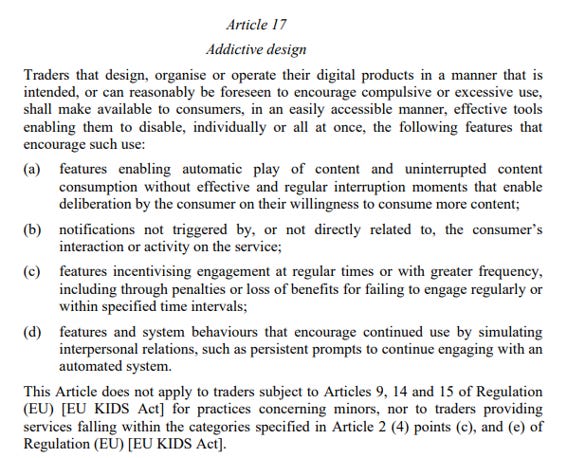
It doesn’t help either that Spain has yet to sort out the national legislation granting the CNMC authority as the national regulator under the DSA. Nor that this is a fundamental problem with the design and operation of many of these providers. It remains profitable to pay a fine and carry on doing the same thing, even when the fines run into the millions. And if the wording of Article 17 of the DFA on “addictive design,” which we’ve included in another section, is maintained, absolutely nothing is going to be solved either.
We should be extremely grateful not to be minors in these times.

You are reading ZERO PARTY DATA. The newsletter on data protection law and artificial intelligence by Jorge García Herrero and Darío López Rincón.
In our spare time from this newsletter, we resolve complicated issues related to personal data protection regulations and AI. If you have any of these, give us a wave. Or contact us by email at jgh(arroba)jorgegarciaherrero.com
🗞️News of the Data world🌍
.- The Digital Fairness Act is getting closer, with news that the draft text the European Commission is going to present has been leaked. The same thing happened with the EU Kids Act, which leaked not long before the draft was released, and now the same has happened with the European Commission's proposed text published yesterday.

This is the regulation that will specifically crack down on dark patterns and addictive design, the already familiar provisions limiting microtransactions in video games (which we already knew about, based on the CPC principles and investigations into specific games), price transparency, commercial profiling of minors, and “influencer marketing.”
It also addresses the increasingly worrying issue of personalized pricing, although from the perspective of prohibiting its application to vulnerable people and minors. And from the perspective that profiling must already comply with the GDPR, and that complying with this obligation does not entail a subsequent obligation to introduce age verification (the same approach as the DSA). The amusing part is that it suggests being able to reasonably determine whether someone is a minor or vulnerable. Exactly what Discord was already saying it could do based on how it analyzes what we click, open, search for or browse.
It remained unclear whether anything relating to the preservation demands of Stop Killing Games would be included, but we’ll be able to see when the European Parliament starts discussing it. The Commission gave them the usual line about self-regulation, but Parliament was the one showing more affection for the initiative.
Watch out for the addictive design issue. Apparently, it never occurred to anyone to impose a requirement that everything be disabled by default. If someone is already caught in the addiction cycle of content designed to be addictive, it takes a special kind of stupidity to think they will exercise restraint without outside help. And faced with algorithms designed so that not even adults are aware of the manipulation, it makes sense to start from the same defenseless position as a minor.
.- Any digital artifact contains enough entropy to reveal more than its creator intended, for example, to geolocate you. The Lobsters community is discussing a video demonstrating how the audio spectrum of an ordinary recording contains Doppler shifts produced by the propellers of aircraft flying overhead. By cross-referencing those signatures with the public database of aircraft positions in the United States, it is possible to triangulate where and when the clip was recorded without a single piece of metadata.
.- Pressure cooker, the film: The European supervisor investigates Europol following the joint investigation by Computer Weekly, Correctiv and Solomon, which revealed that the agency had stored enormous volumes of sensitive data for years in a repository created within its Computer Forensics Network, without the security and data protection safeguards required by EU law. The EDPS confirms a several-month “fact-finding” exercise, supported by anonymous testimony from senior officials and leaked documents describing a parallel processing environment, nicknamed “pressure cooker,” where the guardrails simply ceased to exist.
📖 Hard data documents for coffee lovers ☕️
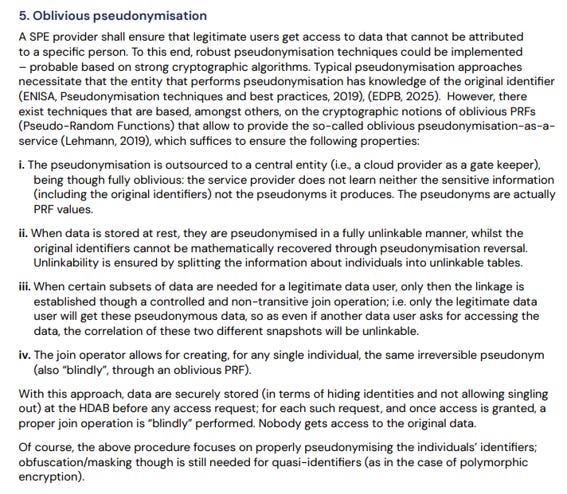
.- The guide jointly released last week by the AEPD and the Greek authority on SPEs (secure processing environments) is interesting. It's a very specific subject touching on Data Governance and data spaces, but it brings to mind some of the more curious PETs: the famous homomorphic encryption, polymorphic encryption or blind pseudonymization.
.- AG Szpunar gives a smart-ass a proper smackdown. An individual used a crawler to scan thousands of websites loading Google Fonts, triggered visits using software and sent letters demanding 170 euros a pop; the method was used more than one hundred thousand times. The Advocate General confirms the relative approach established in Breyer: a dynamic IP address is personal data for a recipient with reasonable means of identification and, indirectly, for the originating website when it knew or should have known that Google could identify the user. But Article 82 requires actual damage: someone who deliberately seeks out the transfer does not lose control over their data; they use it exactly as planned. Next question.
💀Death by Meme🤣
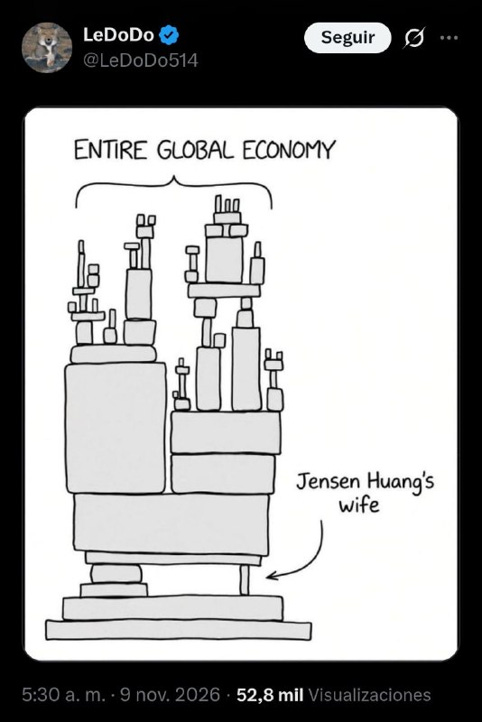
Do we have the moral authority to laugh our asses off at Jensen Huang, the only CEO in global Big Tech who hasn’t behaved like a Marvel supervillain in recent years?
No.
Will we therefore refrain from including a ton of jokes and memes about the subject?
Also no.
That the battered AI bubble might finally burst completely because of the Nvidia CEO’s AI-fueled midlife crisis is something that, frankly, we didn’t see coming.
Fortunately, the little jokes have already been made by actual human beings who are waaaaay funnier than us: we’re just going to collect some of the ones that have made this week an absolute laugh riot.

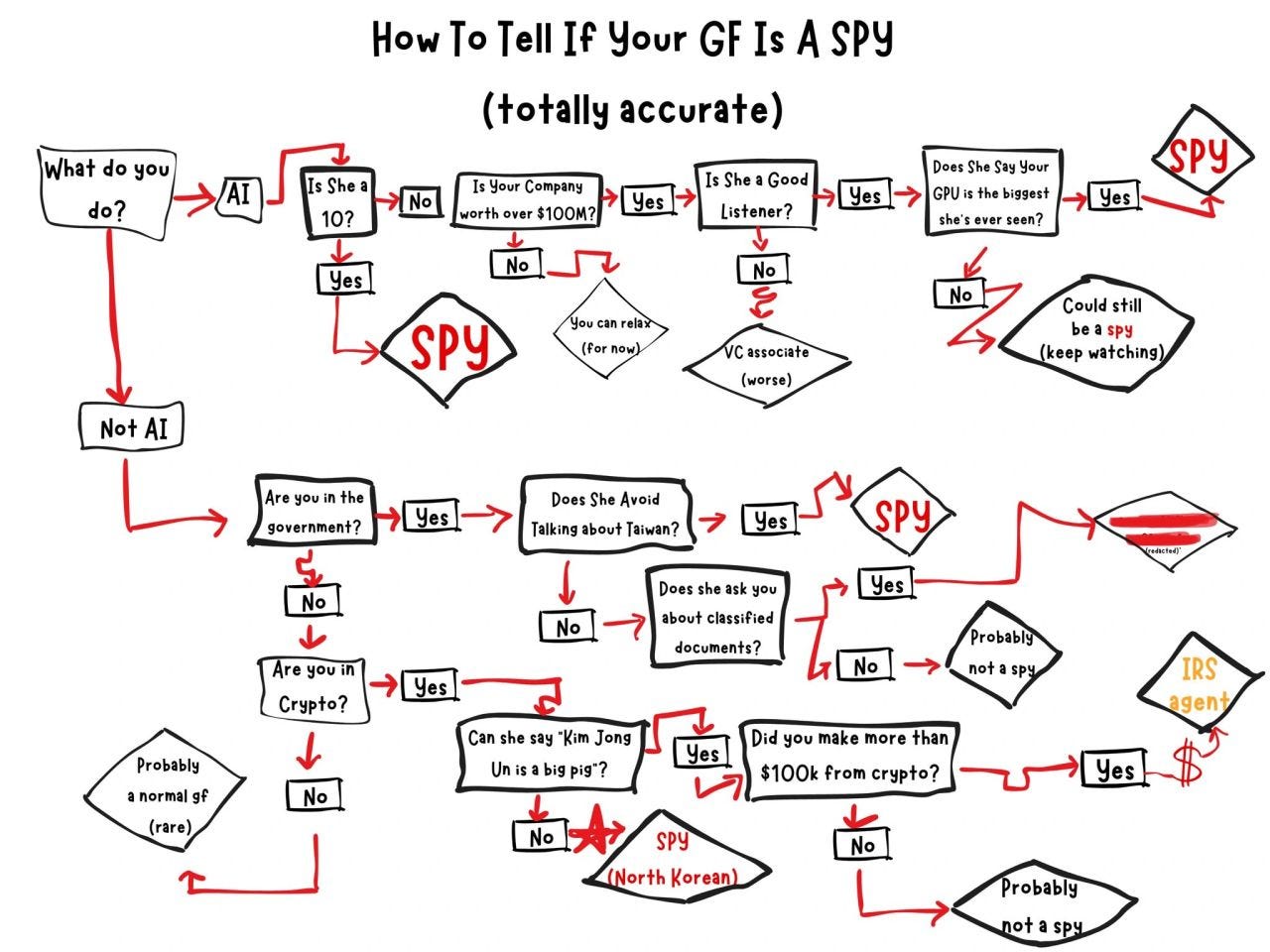
The NVIDIA CEO situation has many possible interpretations and global consequences, but the memes will always come first. And the confirmation of whether Jensen can be considered an honorary James Bond for starring in one of the character's old films: "The Spy Who Loved." Or the updated geopolitical version of "From Russia China with Love."


And they've even managed to find a use for the foldable that Apple has brought back into the debate over whether these devices are a scam or not:


🤖Robots.txt or the AI Stuff
.- Two European authorities have issued opinions, almost simultaneously (and with divergent criteria), on the use of AI in the context of public administrations.
The Hamburg Authority, in this document on “LLMoin”, buries its once loudly proclaimed theories that “LLMs do not contain personal data” and adopts the opposite principle: it cannot be claimed that an LLM has not absorbed personal data, so the opposite assumption applies until the controller proves that it is “anonymous,” if and when they get around to it.
On the other hand, however, it is much more flexible than the Garante regarding the implementation of personal data erasure. Along the same lines, it states that the impact of potentially unlawful training is reduced if the system prevents personal data from being output.
And it is satisfied with that: Hamburg acknowledges that, if there is data in the parameters, Article 17 applies to the model. But it accepts that erasure at parameter level is not technically feasible today and that machine unlearning is not mature. So it settles for mitigation measures.
The Garante remains the most demanding authority. It has issued an opinion on a regulation being developed under a provincial law authorizing the training of AI models using public information assets. Two details stand out to me:
One.- Training a model with personal data from public registers cannot include the categories covered by Article 9 (sensitive data) and Article 10 (criminal offenses) without an enabling law. Without such a law, only synthetic or pseudonymized data may be used.
Two.- The DPIA submitted by Trento acknowledged that, once training had been consolidated, rectification and erasure would not be reflected in the model’s parameters and would only correct the source for future cycles (we’ve seen enough papers here demonstrating that, as things stand today, promising anything else is magical thinking). The Garante, however, classifies that risk as potentially systemic and considers it a violation of Articles 16 and 17. It demands measures guaranteeing the full effectiveness of those rights regardless of the system or model used.
Beef! This can only be settled with a Game of Thrones-style trial by combat.
.- Revolut cuts its costs tenfold for coding inference by abandoning Claude and Codex as the default option and serving the Chinese open-weight GLM model (first 5.1, then 5.3) on 56 Nvidia B200 GPUs. David Abitbol, head of infrastructure, explained at AI Engineer that initial budget limits (engineers spending one thousand or ten thousand dollars a month without any clear return) pushed them toward self-hosting at $0.30 per million tokens. The biggest gains did not come from more GPUs, but from NVFP4 quantization, disaggregated prefill and decode, and 256,000-token context windows because, in his words, the one-million-token context is a scam. And he emphasizes the obvious: a Chinese model raises privacy and security concerns, but he places the real risk in APIs hosted in China; when run on-premises or in a regional cloud, there is nothing to fear.
📃The paper of the week
.- Model collapse (and no, this time we’re not referring to Huang’s relative, harhar): AI models collapse when trained on recursively generated data, according to the Nature paper by Shumailov, Shumaylov, Zhao, Papernot, Anderson and Gal. I know it’s an oldie, but I read it this week.
If GPT- learns from an internet increasingly populated by text from GPT-, the indiscriminate use of synthetic content produces irreversible defects in the resulting models, because the tails of the original distribution (the rare, the minority, the improbable) disappear generation after generation. The consequence they predicted two years ago is obvious today: data on genuine human interactions with systems becomes progressively more valuable as the web fills up with synthetic slop.
Authors: Ilia Shumailov, Zakhar Shumaylov, Yiren Zhao, Nicolas Papernot, Ross Anderson, Yarin Gal.

🛠️Useful tools
.- Want to know what TikTok infers from your face, without uploading your face to TikTok? You can use this website (it runs on your device without uploading files) because it's very interesting. A good exercise in unhinged non-identifying biometrics.
🙄 Da-Tadum-bass
If you're missing a document, comment or piece of nonsense that quite clearly should have appeared in this week's Zero Party Data, write to us or leave a comment and we'll consider it for next time.