

ONE: When a medical photo of your child turns you into a pedophile for Google
February 2021, COVID lockdown. Mark, a father from San Francisco, photographs his son’s inflamed genitals. He’s not a pervert: he does it following a nurse’s instructions for a telemedicine consultation the next day.
The child recovered.
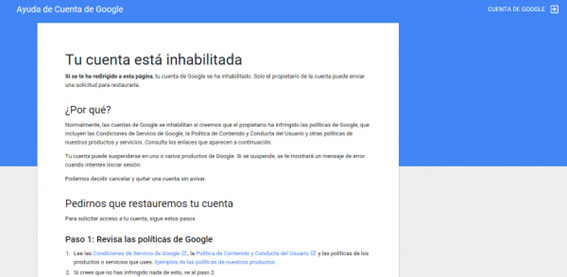
But Google Photos —enabled by default on Android— automatically scanned the image. Its algorithm classified it as Child Sexual Abuse Material (CSAM).
Within hours, Mark lost his digital life: a decade of emails, all his contacts, years of family photos, his phone number (he used Google Fi).
Worse still: Google reported the case to the National Center for Missing and Exploited Children, and San Francisco police opened a criminal investigation.
You are reading ZERO PARTY DATA. The newsletter about current affairs and tech law by Jorge García Herrero and Darío López Rincón.
In the spare time left by this newsletter, we like to solve tricky situations in personal data protection and artificial intelligence. If you have any of those, give us a wave. Or contact us by email at jgh(at)jorgegarciaherrero.com
Thank you for reading Zero Party Data! Sign up!
Acquitted by the law, condemned by Google
The police investigation cleared him of any wrongdoing.
Mark submitted the police report to Google.
Google completely ignored Mark and permanently deleted the account. The only copy of his personal files remained with the police that investigated him (!).
This case, reported by Kashmir Hill in The New York Times in August 2022, is not isolated. The Electronic Frontier Foundation states that thousands of similar cases exist. Every year.
Many of these cases go unreported because victims prefer not to publicize the reason in order to avoid re-victimization.
When Meta shuts down your shop because “You violated community standards”
Who doesn’t know a freelancer or small business whose Instagram account —their main marketing channel— was wiped out with nothing more than “you violated our terms and conditions/policies”?
In summer 2025, Instagram suspended quite a lot of accounts falsely accusing users of child sexual exploitation for posting pictures of cars. A BBC investigation documented over a hundred cases of erroneous blocks.
Meta only restored the accounts after the reputational crisis that followed.
Crappy automated systems + power asymmetry = users disconnected arbitrarily
Aside from the more dramatic cases of false sexual crime accusations, this literally happens every day, and Google or Meta don’t even bother to justify the account bans and deletions.
You surely know of cases personally.
Here’s an example:
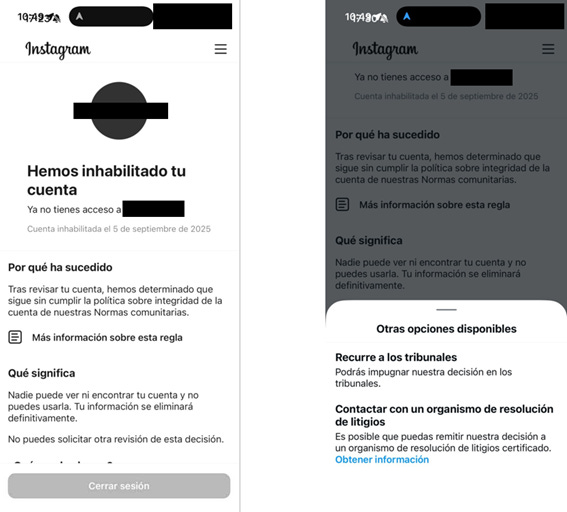
Guilty until proven innocent
When the “lucky winner” of this “lottery” is a freelancer or micro-business without a personal website and whose entire visibility depends on Facebook, Instagram, or Google, the consequences are devastating.
Many of these businesses have invested countless hours in branding / personal branding to build up thousands of followers who make up their market, all lost in an instant.
The DSA has a solution: the Appeals Centre
The figures from Appeals Centre Europe —the dispute resolution body created by the Digital Services Act— are revealing: of the 1,500 cases resolved in its first year, over 75% of the platform decisions were overturned.
That is, three out of four challenged sanctions were incorrect.
This appeals route is barely known: For whatever reason, the platforms themselves don’t inform users of its existence.
How to use this “Appeals Centre”?
If something like this has happened to you on Facebook, Instagram, TikTok, Pinterest, Threads, and YouTube, you can use this channel.
It’s free.
1.- You must first file a complaint with the platform in question.
2.- If you don’t get a satisfactory response, go to
https://portal.appealscentre.eu/
3.- Open an account and “start your dispute”: tell your story.
The decision is not binding on paper, but platforms are complying.
I have personally used similar services (arbitration against abuses from, for example, Disney Plus and they worked splendidly). Read: “refund of a year’s subscription.” Seriously.
The best indicator that it works is that… the DSA forces platforms to inform people of the existence of this Centre and… did you know it existed?
Exactly.
The important thing is that if all affected parties use these procedures, platforms will be forced to comply with the rulings or face sanctions — and DSA fines are no joke.
If Google and Meta can ruin your life… What could happen if —for whatever reason— your daily work bothers a powerful government?
The case of the French judge illustrates it perfectly: “hold my Risketto.”
TWO: The French judge expelled from the 21st century
I read this story several times, but I thought it was part of the crap that slips into my feeds despite all my efforts...
Nicolas Guillou, French judge at the International Criminal Court in The Hague, was part of the panel that issued the international arrest warrant against Benjamin Netanyahu and Yoav Gallant (then Israel’s Defense Minister) on November 21, 2024.
In August 2025, the U.S. Department of the Treasury added him to the “Specially Designated Nationals” list, alongside members of ISIS and Al Qaeda.
The result will surprise you.
Guillou describes his new reality as “a digital regression to the 1990s, before the internet era” and being “economically ostracized in most of the world.”
Amazon canceled his account. Airbnb too. PayPal blocked him.
Expedia canceled his hotel bookings in France.
He can’t shop online because “they don’t know if your product’s packaging is American.”
Visa, Mastercard, and American Express blocked his cards. Even European banks partially limit his services because any transaction in dollars or involving dollar conversion is prohibited to them.
“Some believe that power must serve the law. That is the very principle of international law,” said Guillou. “Others, on the contrary, believe the law must serve power. For them, international criminal justice is an obstacle. It’s an obstacle to empires. That’s why they attack us.”
Sign of the times.
He’s not alone.
The chief prosecutor of the same Court Karim Khan lost his corporate Microsoft account and had to switch to Proton Mail, the Swiss service.

The European response: a thundering silence
The European Union, with its usual recent courage, condemned the sanctions in high-level statements.
Ursula von der Leyen stated that the international court “must be able to act without pressure”.
But when 57 human rights organizations requested the activation of the European Blocking Statute (EC 2271/96) —which would prohibit European companies from complying with U.S. sanctions— the Commission replied maybe some other day, but that it would “closely monitor the implications”.
I think they also closely monitored the tariff issues. Very closely.
France has not publicly defended Guillou. However, it did announce it would not arrest Netanyahu if he visited the country. Italy returned a fugitive from the International Court to Libya. Hungary declared its intention to withdraw from the Rome Statute.
The defense by the European Union of this Court (which has prosecuted genocides such as those in Bosnia and Rwanda) has been, in practice, nonexistent.
That said, last month the Court announced its transition from Microsoft 365 to OpenDesk, a German open-source office suite provided by the German Ministry of Interior’s Center for Digital Sovereignty.
Now we Europeans can sleep soundly.
THREE: LaLiga blocks pirates. And you too.
The third phenomenon —IP blocks (i.e., blocking access to websites) ordered by LaLiga to combat match piracy— represents a uniquely Spanish variant of the same problem:
A private company, LaLiga, managed to convince (this is the mouth opener part) a judge to indiscriminately block IP addresses.
Justice, we expected more from you.
Judges help… LaLiga
Since 2021, the Commercial Courts of Barcelona authorize LaLiga to send lists of IP addresses to telecom operators for immediate blocking during football matches.
The system uses artificial intelligence tools with movie-villain names capable of detecting pirated football match streams in real time. And blocks between 2,000 and 3,000 IP addresses each matchday.
The problem of shared IPs
The fact is that Cloudflare and other providers use shared IP addresses, where hundreds of legitimate websites share the same IP address with the occasional pirate.
Cloudflare also protects its clients through encryption, making selective blocking difficult. That doesn’t stop LaLiga, which uses the judicially granted “golden ticket” to demand bulk encryption blocking.
Collateral damage
The list of victims is endless. And surreal: the Royal Spanish Academy, Madrid City Hall, Twitch, Steam, X (Twitter), ChatGPT, GitHub and —in an Oscar-worthy plot twist— DAZN’s own websites, UEFA, and Girona FC’s football team online store.
When the RAE protested, Javier Tebas responded by threatening legal action for “condoning the sharing of a crime” from his ‘war room’.
The legal front
Both Cloudflare and NGOs like RootedCON and (the ever-reliable Ofelia Tejerina from) the Association of Internet Users have filed lawsuits, which have been dismissed for not proving harm to third parties.
The matter is pending admission to the Constitutional Court.
The road will be long because the Court takes its time and cannot resolve: at most it can annul and return the proceedings to the Commercial Court of Barcelona.
FOUR: Even the Greeks did it better
One of my best teachers was my high school Greek teacher: he taught me lots of interesting things… but very little Greek.
One of them stuck in my memory: when a citizen of a Greek polis caused a major disruption, fellow citizens voted whether to expel them from the city (to sentence them to “ostracism” or exile).
To do this, they wrote “yes” or “no” on a piece of baked clay -the shards of a broken vase, called ostrakon in Greek-.
The votes were counted, and the decision was carried out - or not.
Let’s reflect on this for a moment: even in the most severe expulsion from the community, there was debate, a vote, and transparency.
The accused knew what they were being accused of and could defend themselves. The decision was public and democratic -at least as democratic as democracy was in Ancient Greece-.
Not like today.

CONCLUSION: We want a solution
Cory Doctorow sums it up precisely: tech companies set out to become public utilities as essential as electricity or water. They succeeded. But they behave like private businesses, cancelling services arbitrarily with no possible appeal.
This is unacceptable when the service provided affects fundamental rights.
The three cases we’ve seen —the father accused of pedophilia, the judge expelled from the 21st century, the merchant whose website is inaccessible during matches— have one thing in common: large conglomerates with digital disconnection power operating without real checks.
The Greeks expelled with a citizen vote. Google, Meta, and Microsoft do it “on a whim.”
Trusting in self-regulation isn’t the solution: it is the problem.
The recently proposed “regulatory rollbacks” aren’t the answer either. Europeans need the rules we already have to be enforced.
The DSA includes mechanisms —like the Appeals Centre— that, while imperfect, address these issues. Though their decisions are not binding, they create pressure: if all affected parties use these procedures, platforms will be forced to comply or face serious sanctions.
A bigger boat
We’ll only be able to face this shark by sailing with bigger rights —not with the cutting of rights proposed by the European Commission’s Digital Omnibus.
Condemnation to digital disappearance should not be easier today than ostracism in Ancient Greece.
If you liked Zero Party Data, share it — don’t be like that.